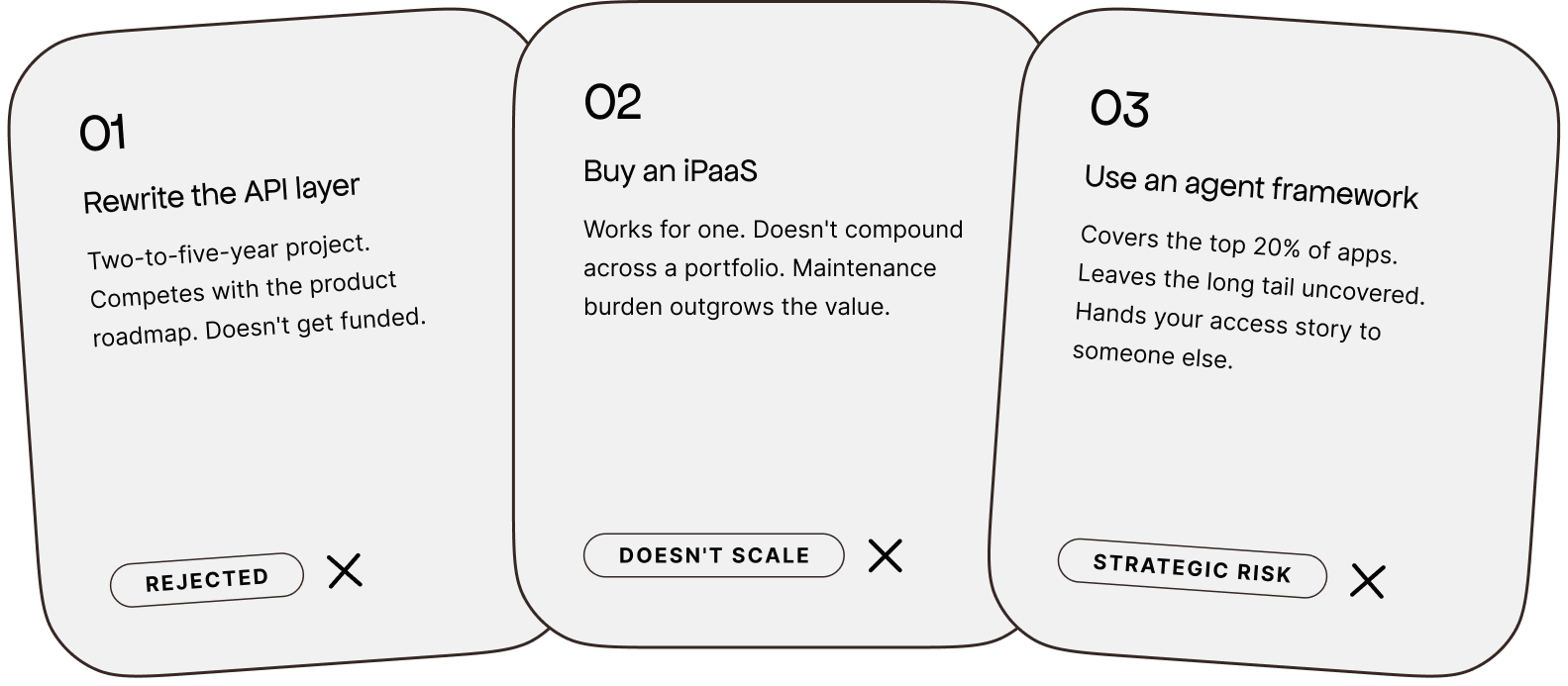
01
Rewrite the API layer
Two-to-five-year project. Competes with the product roadmap. Doesn't get funded.
rejected
Pontil scans your existing APIs and generates the tools your agents need. We keep them current as the product changes. We run them as the authenticated user.
SaaS products spent years being built for the UI. The APIs kept up with some of it. Most of it, they didn't. Now agents need to act on the same surface — and can't get to it. This isn't a model problem. It's an access problem. The agent can reason about what to do. It can't do the thing.
Pontil scans your existing APIs and generates the tools your agents need. We keep them current as the product changes. We run them as the authenticated user.
Want to talk through the specifics for your environment?
Connector generation reads your existing surface and produces structured actions. Tool composition turns those actions into workflows a business user would recognise. Humans approve what gets exposed.

Pontil runs the tools. Retries, timeouts, rate limits, and the auth lifecycle are handled at the runtime layer — not pushed onto your agent or your product.
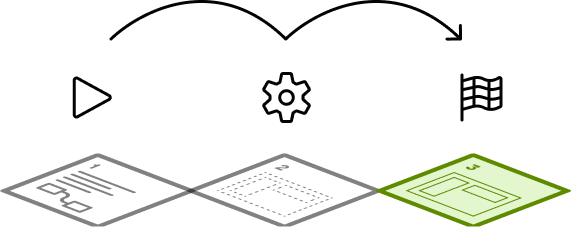
Agents discover the tools available to the current user, fetch current definitions at call time, and invoke them — scoped at the call site. No redeploy to ship a tool update.
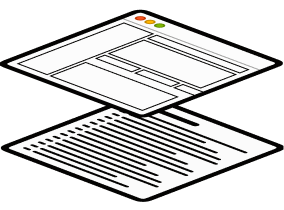
Your customers live in one industry and your product runs deep workflows that exist nowhere else. The UI is rich. The API was built for the integrations that mattered most. Customers are asking about agents, and the API surface doesn't reach what the UI does. Tools are generated from the codebase, not from the published API. Agents reach the workflows your UI runs.
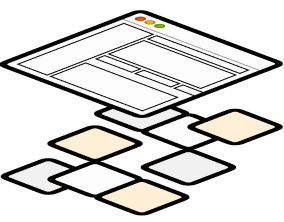
You run dozens of internal platforms — some ancient, some new, none built for agents. Your teams want internal agents and copilots that can actually do things. The platforms behind those workflows are sprawling, undocumented, and impossible to rewrite at portfolio scale. The scanner runs against each app where it lives, generates tools without a rewrite, and keeps them current as the apps evolve.
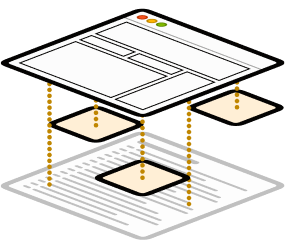
You sell a portfolio. Each product has its own backend, its own API patterns, its own team. An API rewrite for one product is hard enough. Across the portfolio it's a non-starter. Agents need to reach all of it. Tools are generated and maintained across the portfolio in parallel. One platform, one approach, every product.
Don't see your platform? Let’s chat to see if Pontil is the right fit.
Data never leaves your trust boundary. Pontil runs inside the infrastructure you already operate, authenticates as your users, and writes audit trails your security team can read the same way they read everything else.
Want to talk through the specifics for your environment?
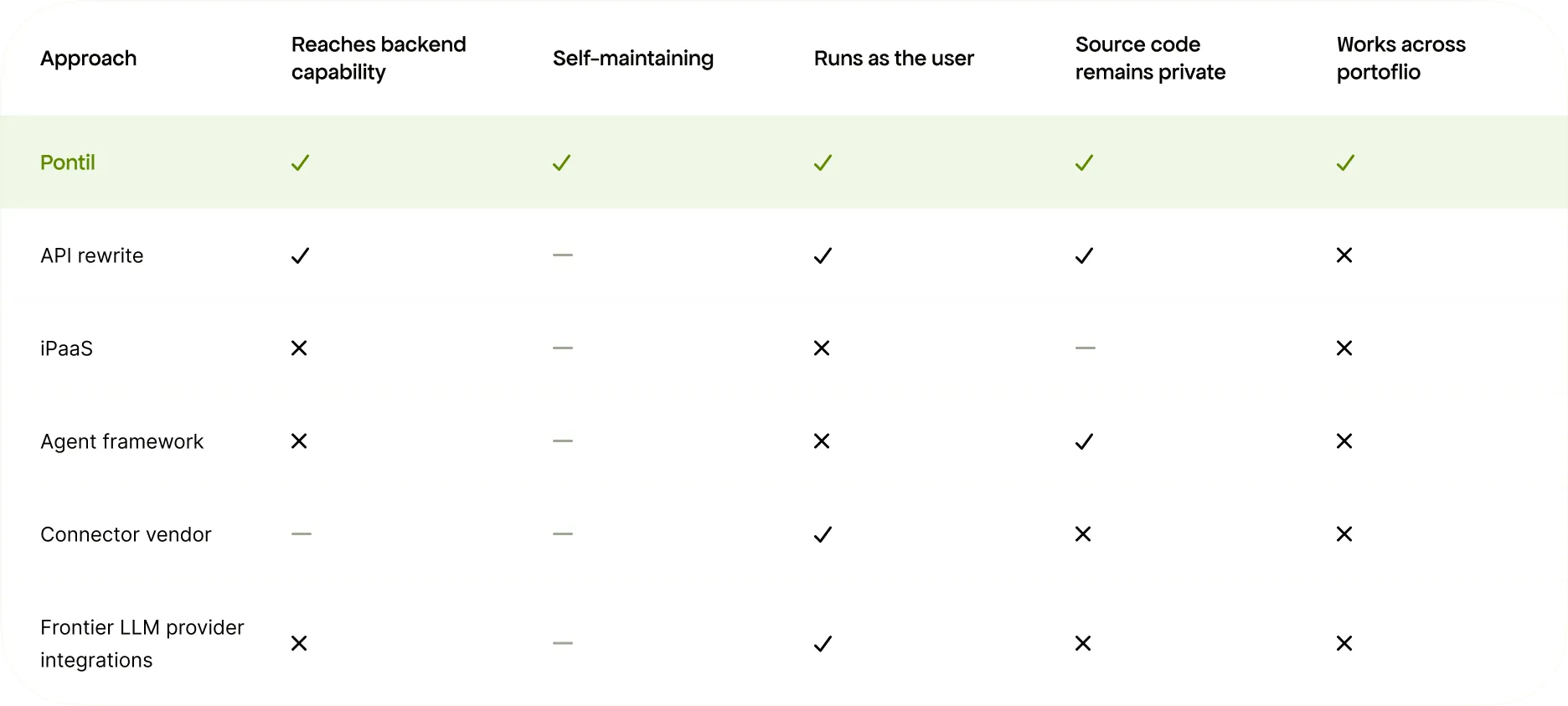
API rewrite
iPaaS
Agent framework
Connector vendor
Frontier LLM provider integrations
Want to talk through the specifics for your environment?